Li Lihong, Zhang Peiyun, Chen Xingyu, Han Lu, Liang Fengling, Jesús M. Cortés. Clinical Efficacy of Acupuncture in the Treatment of Adolescent Depression and Its Mechanism Revealed by Functional Magnetic Resonance Imaging and Serum Proteomics: A Multicenter, Double-Blind, Randomized Controlled Trial. Journal of Traditional Chinese Medicine 67:1858–1867, 2026 [pdf]
Abstract
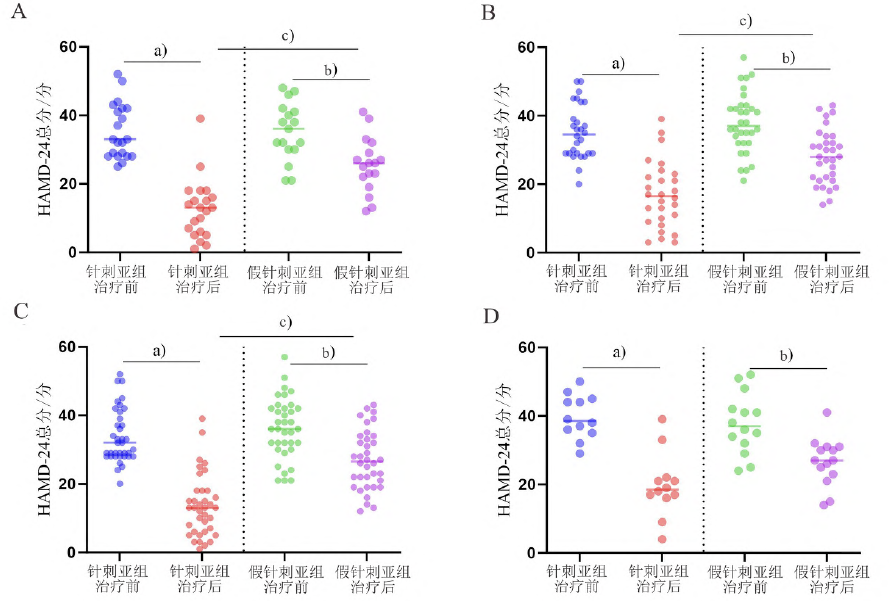
Objective: To evaluate the clinical efficacy of acupuncture in the treatment of adolescent depression and to explore its potential mechanisms based on functional magnetic resonance imaging (fMRI) and serum proteomics. Methods: A randomized, double-blind, sham acupuncture-controlled trial was conducted. A total of 100 adolescents with depression were randomly assigned to an acupuncture group or a sham acupuncture group, with 50 participants in each group. An additional 20 healthy participants were recruited as controls. The acupuncture group received acupuncture at Baihui (GV 20), Yintang (GV 29), Zhongwan (CV 12), Qihai (CV 6), bilateral Tianshu (ST 25), Neiguan (PC 6), Zusanli (ST 36), and Taichong (LR 3). The sham acupuncture group received treatment with blunt placebo needles that did not penetrate the skin. Both groups received 30-minute sessions three times per week for 4 weeks. The primary outcome was the reduction rate in the 24-item Hamilton Depression Rating Scale (HAMD-24) score. Secondary outcomes included changes in HAMD-24 scores and its nine factors, response and remission rates, symptom severity, subgroup analyses by medication use, and adverse events. Eligible volunteers underwent brain fMRI and serum proteomic analysis. Results: Efficacy analyses included 49 participants in the acupuncture group and 50 in the sham acupuncture group. fMRI scans were completed by 20 and 21 participants, respectively; serum proteomic analyses were completed by 19 and 21 participants. After 4 weeks, the mean HAMD-24 reduction rate was significantly higher in the acupuncture group than in the sham acupuncture group (58 ± 24% vs. 26 ± 19%; P < 0.01). Both groups showed reductions in anxiety/somatization, cognitive impairment, psychomotor retardation, hopelessness, and total HAMD-24 scores. The acupuncture group also showed reductions in sleep disturbance, fatigue, and suicidal ideation (P < 0.01). Response and remission rates were 67.35% (33/49) and 24.48% (12/49) in the acupuncture group, compared with 6.00% (3/50) and 0 in the sham acupuncture group (P < 0.01). Four mild adverse events were reported, with none affecting treatment continuation. fMRI results indicated that acupuncture enhanced functional connectivity between the prefrontal cortex and brain regions associated with the cerebellar-limbic system. Proteomic analysis identified 24 differentially expressed proteins associated with acupuncture, mainly enriched in pathways related to neuroinflammation and energy metabolism. Conclusion: Acupuncture can significantly improve depressive symptoms in adolescents. Its effects may involve modulation of emotion-related brain networks and pathways associated with neuroinflammation and energy metabolism.