Felipe A. Torres, Alejandro Weinstein, Jesus M. Cortes, Wael El-Deredy. Intrinsic resonance depends on network size for coupled-delayed interacting oscillators. Physical Review E. In
press, 2026 [pdf] arXiv: [2511.14065v1]
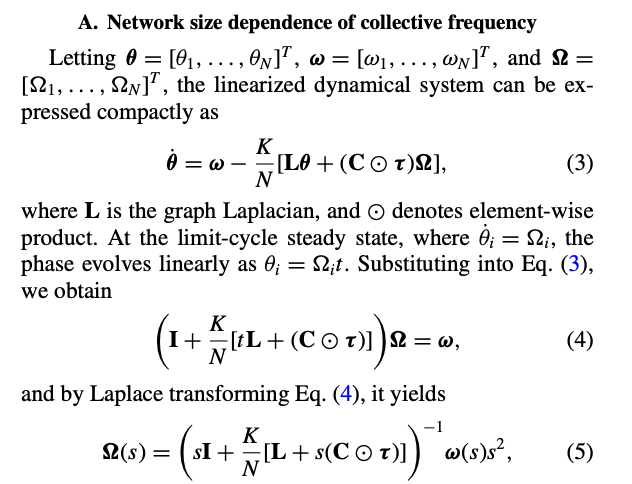
The collective frequency that emerges from synchronized neuronal populations—the network resonance— shows a systematic relationship with brain size: a whole-brain large network oscillates slowly, whereas finer parcellations of fixed volume exhibit faster rhythms. This resonance–size scaling has been reported in delayed neural mass models and human neuroimaging, yet the physical mechanism has remained unresolved. Here, we show that size-dependent resonance follows directly from propagation delays in delay-coupled phase oscillators. Starting from a Kuramoto model with heterogeneous delays, we linearize around the near-synchronous solution and obtain a closed-form approximation linking the resonance to the mean delay and the effective coupling field. The analysis predicts a generic scaling law, so resonance is delay limited and therefore depends systematically on geometric size or parcellation density. We evaluate four growth scenarios—expanding geometry, fixed-volume parcellation, constant geometry, and an unphysical reference case—and show that only geometry-consistent scaling satisfies the analytical prediction. Numerical simulations with heterogeneous delays validate the law and quantify its error as a function of delay dispersion. These results identify a minimal physical mechanism for size-dependent cortical resonance and provide an analytical framework that unifies numeric simulation outputs.