Izaro Fernandez-Iriondo, Antonio Jimenez-Marin, Naiara Aginako, Gorka Zamora-López, Asier Erramuzpe, Paolo Bonifazi, and Jesus M. Cortes. Modular structure-function coupling reveals different network reorganization for task performance. Communications Biology, In press, 2026 [pdf]
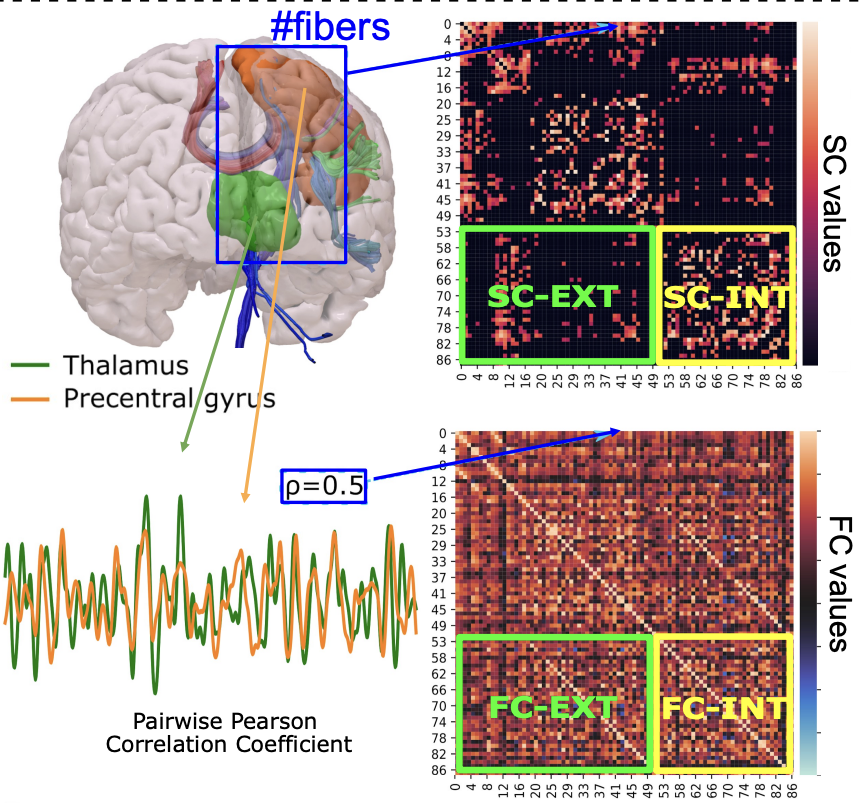
Understanding how structural and functional brain networks interact to support cognition remains a central challenge in systems neuroscience. Here, we investigated modular structure–function coupling (SFC) across cognitive tasks using multimodal neuroimaging data. We separated SFC into intra-modular coupling (SFC-INT), measuring alignment within structural modules, and inter-modular coupling (SFC-EXT), measuring alignment between each module and the rest of the brain. This decomposition revealed that between-module coupling was more sensitive to task demands than within-module coupling. Moreover, different tasks produced distinct rest-to-task displacement patterns in the SFC-INT vs. SFC-EXT representation, indicating task-specific reconfiguration of the same anatomical structure. Brain–behavior analyses further suggested that performance is better captured by coordinated SFC profiles across modules than by isolated module-level effects. Together, these results provide a modular framework for studying how task demands reshape the relationship between brain structure and function.